
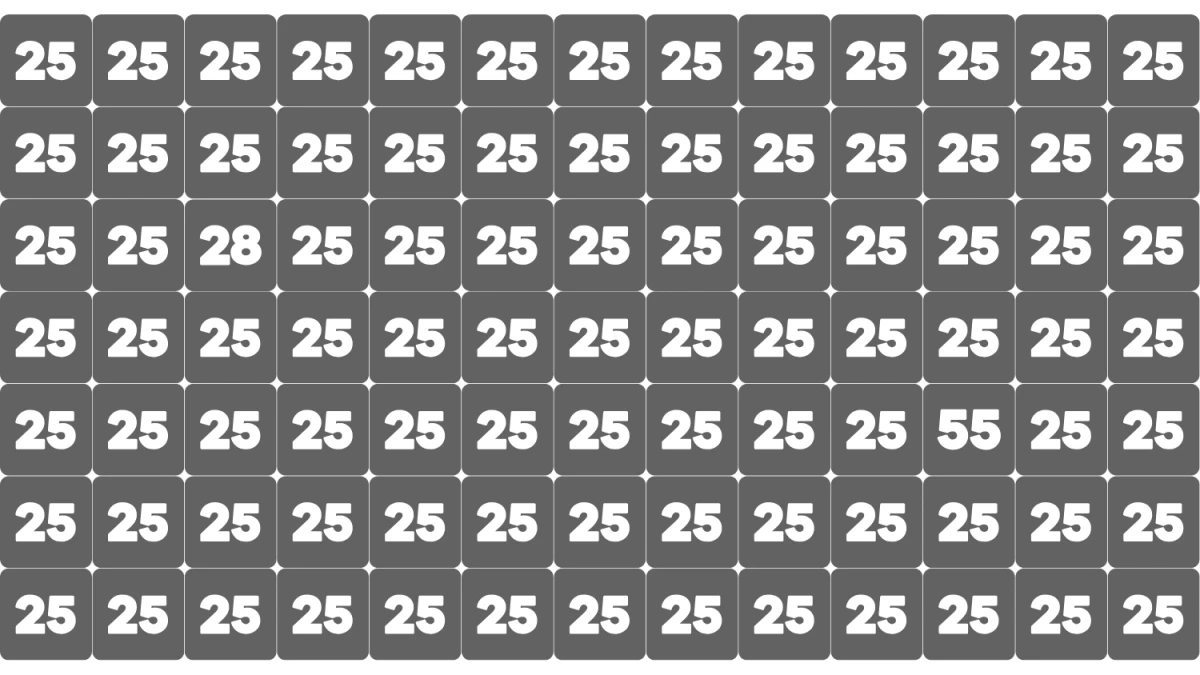
A new number-spotting optical illusion is circulating online, and it is tricking viewers with its clever design. The image appears to be filled entirely with the number 55 repeated hundreds of times. But somewhere in the grid, the number 28 is quietly hiding. The challenge is simple yet surprisingly confusing: can you find the hidden 28?
Why the Number 28 Blends So Easily with 55
At first glance, 55 and 28 look nothing alike. But when placed in a tight grid, the brain begins to focus more on repetition than on detail. As your eyes adjust to seeing only 55, everything begins to look the same. This mental expectation makes the slight difference in shape harder to detect, allowing the number 28 to blend almost perfectly into the pattern.

How to Improve Your Chances of Spotting It Quickly
Instead of scanning the image randomly, move your eyes slowly in a structured direction — such as left to right or top to bottom. This method reduces visual overload and allows your brain to catch irregular shapes. Pay extra attention to the curves of the number 2 and the straight lines of the number 8, as these features stand out when compared to the repeated 5s.
Try the Challenge and Test Your Observation Skills
Take a few seconds and see if you can find the hidden number 28. Some people spot it instantly, while others spend much longer searching. The illusion becomes even more entertaining when shared with friends or family to see who can identify it the fastest.

Why Optical Illusions Help Improve Brain Function
Optical illusions like this challenge your brain to look beyond automatic assumptions. They improve visual processing, strengthen attention to detail and increase pattern-recognition skills. Regularly engaging with these puzzles helps sharpen your mind and enhances cognitive flexibility.
Did You Find the Hidden 28 or Is It Still Elusive?
If you located the number quickly, your observation skills are excellent. If not, don’t worry — the illusion is designed to trick even sharp-eyed viewers. With a bit of practice, your ability to detect subtle differences in similar patterns will improve dramatically.

Conclusion: This optical illusion is a quick, fun and mentally stimulating way to test your perception. The hidden 28 blends cleverly among the many 55s, offering a satisfying challenge for puzzle lovers of all ages. Share it with someone else and see who can spot it the fastest.
Disclaimer: This article is for entertainment and cognitive-awareness purposes. Puzzle difficulty may vary depending on the version used.
